
Measles
Measles diagnosis and testing
- Patients with a compatible rash illness should be isolated immediately. Follow the advice in the IPC Measles At A Glance document for guidance on clinical diagnosis and testing.
- Urgent testing can only be arranged after notification to the local health protection team (0344 225 3861) who can arrange an urgent swab and courier if required.
- For background information see Measles: the green book
- For full guidance see the National measles guidelines
Further details about testing
Urgent measles testing for patients or staff in OUH
The HPT should be notified of all suspected measles cases (0344 225 3861) and will do a risk assessment, and manage contacts in the community as per UKHSA guidelines (National measles guidelines July 2024). Contacts in the Trust will be managed according to national guidelines with assistance from the IPC and Infection teams (adult or paediatric).
Urgent measles testing requires approval from the HPT.
Notify the IPC team if not already aware.
Postal swab surveillance of measles by UKHSA remains in place for all cases notified to the health protection team (HPT) (non-urgent cases) and will be arranged by the HPT. These usually take about 2 weeks to be processed.
If the HPT determine that urgent testing may influence public health actions e.g. contact management, and where there is uncertainty about whether the case truly has measles, they can arrange testing for this purpose (usually measles PCR for viral RNA, depending on the sample type and elapsed time from symptom onset).
UKHSA testing is done through the Public Health Laboratory (PHL). The PHL will accept oral fluid kits (OFKs) OR swabs in MWE virus transport medium – these are green topped containers.
UKHSA’s measles OFKs are held in Microbiology on level 7 (Contact microbiology reception 20874). For urgent testing of inpatients (which must be agreed with the HPT beforehand), OFK need to be collected from level 7 by the clinical team or taken to the clinical area for sample collection and returned to Microbiology. Alternatively an appropriate swab in viral transport medium can be used (see above) – but OFK is preferred if possible.
HPT will arrange a courier to collect the OFK/swab from Microbiology once the swab has been taken. Courier will transport the OFK/swab to PHL.
If patient has gone home:
· In office hours the HPT will arrange for a courier to take an OFK from their office supply to the patient and on to PHL.
· Outside office hours, the courier will collect a swab from Microbiology level 7 and take to the patient’s home and on to PHL.
Results will be issued to the HPT, who will inform IPC of the result by phone and/or email to ensure follow-up of public health actions within the OUH
Management of contacts
See IPC Measles At A Glance document
Non-vulnerable contacts - MMR Vaccine
- Non-vulnerable contacts with incomplete measles vaccination history (i.e. less than two doses of a measle containing vaccine) and a negative history of measles infection should be offered the MMR vaccine, ideally within 72 hours of exposure.
- Vaccine-induced measles antibody develops more rapidly than that following natural infection, and there is some evidence that it may prevent diseases or reduce its severity. Even where it is too late to provide effective Post Exposure Prophylaxis (PEP) with MMR, the vaccine can provide protection against future exposure to all three infections (measles, mumps and rubella) and individuals should still be opportunistically vaccinated.
- If there is doubt about an individual’s vaccination status, MMR should still be given as there are no ill effects from vaccinating those who are already immune.
- If the individual is already incubating measles, MMR vaccination will not exacerbate the symptoms. The typical incubation period is 10 to 12 days from exposure to onset of symptoms but can vary from 7 to 21 days. In these circumstances, individuals should be advised that a measles-like illness occurring shortly after vaccination is most likely to be due to natural infection.
- MMR vaccine should only be arranged during the day (9am-5pm, Mon-Sun)
Vulnerable contacts - human normal immunoglobulin (HNIG)
- Although PEP is of limited effectiveness, there may be an opportunity to offer some protection to exposed vulnerable contacts with HNIG, namely infants (up to 6 months or 9 months if household contact), pregnant women and immunosuppressed patients.
- Vulnerable contacts should be rapidly assessed as, where indicated, HNIG should be given within 6 days of exposure (ideally 3 days for some immunosuppressed individuals and infants up to 9 months)
- People with severe defects of cell mediated immunity who are on regular Intravenous immunoglobulin (IVIG) replacement therapy do not require additional IVIG if the most recent dose was administered 3 weeks or less before exposure.
- To decide which patients may benefit from HNIG, Infection Prevention and Control (IPC) team will assist clinical staff to assess:
- measles vaccination history
- prior measles infection
- nature and level of immune suppression if present. (Micro/ID can assist in defining when assessing for HNIG). (See National measles guidelines Annexe 2. Classification of immunosuppression (measles))
- Once this information has been gathered, discuss with Micro/ID with support from Infection Control doctor who will assess the need for HNIG.
- A rapid measles IgG test may be required to assess immunity to measles. Results should be available within 24 hours or less from the OUH microbiology department.
- HNIG does not need to be arranged overnight (8pm-8am). If a vulnerable contact is approaching the end of the recommended window since exposure, then overnight administration can be considered but the additional risks must be considered
Immunosuppressed patients
- Identify which classification of immunosuppression the patient meets, see the relevant tables in National measles guidelines 2.2.3 Immunosuppressed patients
Pregnant women
- Recommendations for pregnant women are based upon a combination of age, history and/or antibody testing. See National measles guidelines 2.2.4 Immunocompetent vulnerable contacts: pregnant women for full definitions.
Infants
- Recommendations for infants are based upon age due to short-lived passive maternal immunity and interference of maternal antibodies with the MMR vaccine. See National measles guidelines 2.2.5 Immunocompetent vulnerable contacts: infants for full definitions.
- Due to interference from maternal antibody, the efficacy of a dose of vaccine provided between 6 to 11 months of age is lower than that provided at 12 to 13 months, and therefore doses offered before one year of age should be discounted and children should be offered 2 doses of MMR vaccine according to the national schedule.
Prescribing HNIG
Immunoglobulin (HNIG) for measles requires:
- Micro/ID approval
- Immunoglobulin Request Form completed on the Immunoglobulin Database
- EPR Prescription
HNIG for measles does not come from the UKHSA Rabies and Immunoglobulin Service. Supply will be made from the hospital pharmacy.
Ensure the pharmacist (see screening section below) is promptly contacted before prescribing to ensure the correct brand is prescribed
Immunoglobulin dose and brand:
Subgam, Cutaquig and Hizentra are the recommended products. Note that the intramuscular (IM) route is off-label but recommended as absorption is faster than the subcutaneous (SC) route.
*Cuvitru can be used if no other product is available but IM administration is not routinely recommended. SC administration would be suitable but due to slower absorption is likely to be associated with delayed action. Depending on clinical urgency, off-license IM administration based on a benefit-risk discussion would be a consideration. See National measles guidelines 2.3.2 Immunocompetent infants and pregnant women
|
Vulnerable Patient Group |
Product to prescribe |
Dose and administration |
|
Infants (up to 8 months) |
Subgam, Cutaquig or Hizentra (depending on availability) or Cuvitru* |
0.6ml/kg (max 1g) intramuscular – max 3ml per site See national guidelines if Cuvitru used |
|
Pregnant women |
Subgam, Cutaquig or Hizentra (depending on availability) or Cuvitru* |
3g intramuscular - max 5 ml (Can administer subcutaneously into thigh if abdominal wall too tight) See national guidelines if Cuvitru used |
|
Immunosuppressed |
Pharmacy will advise on available brand. |
0.15g/kg intravenous IVIG infusion For obese patients, ideal bodyweight (IBW) should be used to calculate the dose. Round the dose down to the nearest 2.5g |
Intravenous immunoglobulin (IVIG) should be prescribed using the respective powerplan. The pre-infusion and infusion -reaction medications should also be prescribed. E.g for Gamunex:
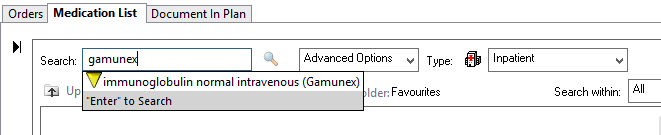
Subcutaneous immunoglobulin should be prescribed using the order sentence on EPR as with other standard drugs
Before pharmacy can supply, a referral must be completed on the online Immunoglobulin Database by a doctor.
Screening HNIG
Measles HNIG should be screened by the following pharmacists:
| Mon-Fri (9am-5pm) | Sat (9am-5pm) | Sun & Bank Holidays (9am-5pm) | Out of Hours | ||
| 5pm-7pm | 7pm-8am* | 8am-9am | |||
| Ward pharmacist |
AMS pharmacist #1549 |
Dispensary pharmacist #1884 |
On-call #1884 |
On-call via Switchboard |
On-call #1884 |
*Immunoglobulin does not need to be arranged overnight (8pm-8am). If a vulnerable contact is approaching the end of the recommended window since exposure, then overnight administration can be considered but the additional risks of administering immunoglobulin overnight must be considered.
*MMR vaccine should only be arranged during the day (9-5pm, Mon-Sun)
For immunosuppressed, non-pregnant adults the current preferred IVIG product is Gamunex but this may change based on local availability.
Ensure IVIG is prescribed using the respective IVIG PowerPlan, including pre-meds.
Refer to the respective Medusa injectable monograph for method of administration, including recommended infusion rates.
A referral must be completed online for a supply to be made.
Dispensing HNIG
Dispensing measles HNIG follows the same procedure as for all OUH pharmacy HNIG supplies.